Kamis, 25 Maret 2010
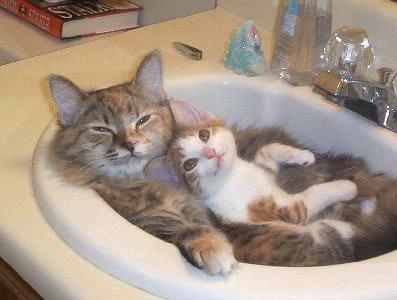
Feeding Companion Animals
Senin, 22 Maret 2010
Easy Paper Butterfly Crafts
Inflatable Butterfly Newspapers
Materials
Newspapers
A variety of colors of paint. You can use the red, white and blue, then mixed, producing a variety of colors pink and purple
Suture east and west sides, stapler, hole puncher, or with a rope or wool
Directive
Oblique fold paper to make paper to form a triangle.
Staple or both accounted for using the punch of the punching, and then use a string or wool stitched on both sides.
Open the bag you just created something which is full of newspapers collapse.
Now staple or suture closure of the other party.
Repeat the whole process, so that the second triangle or butterfly wings.
There is a comprehensive presentation and the two newspapers had folded. At this time it is you want to fold the rectangle. Then fold one half, so that you are a body.
Staple or sew around the way the two sides.
Open the body and stuffed with newspapers, and it collapsed.
Staple or suture closure of the third side.
Paint a base color of butterfly wings.
Dry.
Add a second layer necessary.
The butterfly body paint color.
Decorative sponge wings, and even cut the potatoes with the paint.
Dry.
Paint or color as to their eyeballs and glue them on the human body.
Cut out a mouth and paint or color, and glue to the body.
Staple the wings on the body.
Hang butterfly ceiling or wall.
Caterpillar and butterfly Fingerprint Technology
Materials
Paper
The temperature of the finger paint or paint colors. Keep in mind that if you use two or more colors, you need to wash your hands between the time in
Black mark
Directive
Dip paint, you want your fingers and thumb on the document image according to the paper. Here are some suggestions, you can use the Getting Started:
Please turn the color of your thumb, and put them straight caterpillars.
A fingerprint flowers with 4 petals and leaves two print photos.
A similar fingerprint Butterfly 4 color printing, but also can be used for the top wing and one under the wings of a two-color.
A fingerprint sun, a print into a circle, a group of.
A fingerprint shrubs, printed into bundles.
Finger grass, finger straight, horizontal laying.
You can use a single fingerprint, and formulated the wrong legs, their faces.
For your less experienced craftsmen with a pencil on paper to make a small mark to be placed in their thumbprint, which helps them to make their own, let us look like a caterpillar larvae.
Sabtu, 20 Maret 2010
Capturing the Natural Behavior of Butterflies in a Photograph
Timing is very important, because most of the topics of Mother Nature. In time to photograph is just before dawn, as they seem almost motionless. You have to look very carefully when you walk through the meadows. Search from the ground up tree branches and strains.
Move slowly and will make lots of activities in two to three hours after sunrise. If you are lucky enough to hit one before it flies so well and the tireless search for food away from yourself you have been hoard size. Patience is a great asset when trying to photograph butterflies of their natural habitat.It is hard to believe that there are 700 kinds of butterflies in North America and more than 20,000 worldwide. You can usually get a lot of good hitting, right from your backyard and nearby parks. It is also to visit the aviary can capture butterflies, if you're not so much interested in capturing the beauty of their natural habitat.
Proper identification is important butterfly photography. There are many good books that will help you have the proper identification. Photographs of butterflies in its natural habitat, or aviary is almost always positive, in addition to his photography portfolio.
Easter Butterfly Decorations
Decorating for Easter is an annual tradition, and Mark in the spring. If it is spring fever strikes, I know it is time to change the inside to match outside. I start pulling out my favorite plants and place them more prominently in the room. Spring is not spring without flowers and butterflies, that they follow the way of plants.
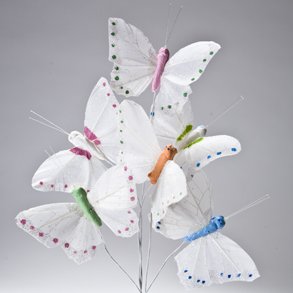
I like to make a new, fresh flower bouquets and arrangements for the season and add a smaller nylon butterflies among the flowers. Small nylon butterflies give a similar yet different from the feeling that they tie in my topic, but it is not repeated. For example, one area I use a nylon butterflies gracefully adorned with sparking crystals, jewelry, or trying to sunlight. In the second, I have a sequined type. Sometimes I Hang beautiful butterflies among the daisies, or Ladybug truly magical feeling. Close to Easter, bunny decorations and add eggs into the mix the egg Hunt.
We've not only nylon butterflies and spring decorations, but also the cloud wall stickers and even some beautifully decorated with the alphabet letters of the Spring issue. Room now shines. We have created an inspiring and exciting place to enjoy the wonder and newness of spring and get ready for Easter fun and innovation.
Selasa, 09 Maret 2010
Tropical Butterflies in the World's Tropical Rainforests
If you are fortunate enough to visit a rainforest you will no doubt be eager to look at the birds and animals within. Yet, for many visitors, although they can hear the sounds of the wildlife, seeing it is another thing. Some of the rainforest`s animals are nocturnal, and the birds are in the canopy of the forest.
One creature you are likely to see, though, is the tropical butterfly.
Butterflies are important rainforest insects. They feed on nectar, and are important because they pollinate flowers.
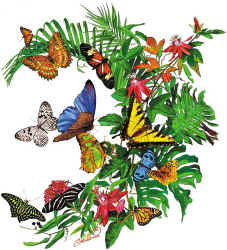
Tropical butterflies are often larger than those you may see in your garden, and many boast beautiful colors. The green of the forest is an ideal backdrop for the brilliant blue, red, and yellow butterflies that flit about in the clearings. Apart from these traditional colors, in South America you may also see butterflies with transparent wings. Not all butterflies are colorful, some are camouflaged to resemble leaves, or the bark of trees.
Tropical rainforests are the most diverse ecosystems on earth. The number of different butterfly species inhabiting the rain forest is amazing. An eight-square kilometre area of rainforest contains as many as 1500 species of flowering plants, 750 species of trees, 125 species of mammals, 400 species of birds, 100 species of reptiles, 60 species of amphibians, and 150 species of butterflies. More than half of the world's plant and animal species inhabit the 6 percent of the world that is covered in rainforest.
Although a butterfly's wing may exhibit a full range of colors, these hues generally do not depend on many different pigments. The wing comprises a transparent membrane on which thousands of tiny scales are attached, and each scale usually has just one pigment. However, scales of different colors combine to give the impression to the observer of yet another color.
In a study by The University of Exeter, UK, research appears in the journal Science. The study concluded that fluorescent patches on the wings of African swallowtail butterflies work in a very similar way to high emission light emitting diodes (LEDs).
Unlike your garden at home, because most flowers bloom high up in the canopy, where they provide nectar for the butterflies, they cannot be seen by a visitor on the ground. Fortunately, male butterflies come down to earth for salt. It is thought that the mating process may deplete them of necessary minerals, which they replenish by sucking up moisture from wet ground. Thus, a damp forest path or the edge of a small stream may prove the ideal place to observe the butterflies of the rain forest. This partly explains why males constitute the vast majority of butterflies clustering around salty ground. Butterflies seek out salt to obtain additional compounds they need to function as adults; the plants they ate when they were caterpillars had low levels of some crucial compounds. For example, plant tissues have relatively little salt, which is essential for all animals.
Endangered Rainforest Animals For Your Kids to Know
Children need to be educated about our planet and all the different life forms that inhabit the earth. Teaching a child about the millions of species of animals that exist in this world, half of them in the rainforests, is a good thing. This article on the endangered rainforest animals for your kids to know covers some of these animals in danger of extinction to create awareness among children. Since our children are the future of our country, teaching them is our duty.
Children need to be made aware that most animal extinction and endangerment is caused by human activities. There are many animal rights activists who strive valiantly to save the endangered species and stop extinction but it is a long, hard battle. Rainforests are under constant threat and saving the rainforest means saving the animals that inhabit the forest. Tropical rainforests are considered to be nature's largest pharmacy due to the numerous natural medicines found there.
A few of the better known endangered rainforest animals for your kids to know include:
Gorilla - found in the west central African rainforests of Zaire and Rwanda are in danger of being wiped out through loss of habitat and being hunted as bush meat. The Ebola virus has already done significant damage to the Gorilla population.
Golden Lion Tamarind Monkey - is probably one the most endangered of all the rainforest animals and is nearly extinct. The fur of these monkeys is extremely valuable and can fetch as much as 20,000 dollars on the black market. Their number has diminished drastically and only a few of the species are to be found in the Brazilian rainforests.
Jaguar - one of the sleekest of all beasts of prey, this magnificent animal is on the endangered list. Hunting although prohibited in most countries continues to drive the species nearer to extinction with each passing year.
Bengal Tiger - there are only approximately 4000 of these animals left in the wilds of the Sundarbans in India, Bangladesh, Indonesia, China and Siberia. When you consider that they numbered roughly 50000 in the 1900s, you will realize how much damage man has done by poaching not just these beautiful animals but their land.
Most of us know and love the Orangutan and it is sad to know that these cute creatures with their mops of orange hair are on the endangered list. Destruction and loss of habitat coupled with poaching and being hunted as an exotic species have led to the decline in numbers.
This list is only the beginning of a very long list of endangered rainforest animals for your kids to know. Encourage them to visit as many sites as possible to learn more and teach them to be motivated towards saving the endangered animals.
Kamis, 04 Maret 2010
Peruvian Animals
The Amazonian basin covers almost sixty percent of Peru. The jungles of Peru are inhabited by pumas, jaguars, and birds such as the macqua and the toucan. Some of the other unfamiliar creatures are the Incan hairless dogs, otherwise known as Peruvian Inca Orchid.
The Andean regions of Peru house the llamas and alpaca. The llamas are bred for the meat and the alpacas, for fur that is used for making wool. Birds in this country are also a diverse lot. The largest flying bird on earth is the condor, and it resides in this country. Condors have a wingspan of eight to ten feet. The specialty of these birds is that they can cruise along the skies for hours without flapping their wings even once.
Around four thousand species of butterflies are found in Peru. Many species of animals that are found in Peru are considered to be endangered species, and authorities are trying their best to save these species. The humpback whale is among the most vulnerable species that needs protection from hunters and fishermen. The Andean cat is also a member of the endangered species list.
Due to the varied geographical climate and terrain of Peru, its flora and fauna are diverse. The coastal regions have a varied sea life. The inland mountainous region is colder than the low-lying areas of the Amazon River. Furry seals make a pleasant picture on the beaches in the Pacific coastal regions of Peru. Pelicans and gulls can be found flying in Peru's coastal skies.
Pink dolphins and the Andean spectacled bears are found near the Amazon River. The giant river otters are also a familiar sight near this river along with the Tapirs and howler monkeys.
The Peruvian government does not have the funds to conserve many of its endangered species. However, help is sought from foreign agencies to protect these species. Agencies such as the World Wild Life Fund sponsor the protection of these birds and animals.
Animals on the Move
Some animals are constantly on the move, whether in the continual search for food or territory, or as part of a seasonal migration. This year, because of the intervention of wildlife conservationists, there are some animals on the move for very different reasons.
The Panda Express
A giant panda named Tai Shan made the news in February 2010 when he emigrated from the USA to China. He was moved from the Smithsonian National Zoo in Washington DC to join a breeding programme run by wildlife conservation experts at the Bifengxia Panda Base in Ya'an, Sichuan. Tai Shan's intercontinental blind date and breeding plan is so high profile that he has even attracted a sponsorship deal from a car company.
A special FedEx plane was chartered to transport him and a panda called Mei Lan, from a zoo in Atlanta, to China, a journey taking fifteen hours. On the flight, dubbed "the Panda Express", were about 18 kilos of bamboo, pears and apples to keep him occupied. He was not anaesthetized for the journey because expert wildlife conservationists allowed him to get used to his cubicle long before it was time to leave. He will be given a month to settle in before he is introduced to the Chinese public.
Tai Shan was born in America in July 2005 to Chinese parents. He is the first cub that the zoo has successfully raised to this stage of maturity. Scientists used artificial insemination in his conception with the help of Chinese zoologists who loaned his parents to the U.S. for that purpose. As part of the project, it was negotiated with the China Wildlife Conservation Association that he would stay for a term of about two years, but he proved so popular in America that his residency was extended for a further two years.
It appears that he will be fondly missed; to coincide with the panda's departure, the zoo has launched a series of postage stamps bearing his image, the proceeds from which will go towards wildlife conservation projects like the one that has made Tai Shan headline news.
Monkey Business
About 450 km to the East of Tai Shan's new home is Chongqing Zoo, where you can also find pandas. Chongqing Zoo looks after a number of endangered species such as Great and Lesser pandas and South China Tigers, which are being monitored and bred as part of wildlife conservation programmes. But in the first week of February 2010, it was not the protected animals that caught the attention of the visiting crowds, but those that escaped the protection of their enclosures and made a break for freedom.
Somehow, a few of the zoo's more mischievous monkeys climbed out of their enclosure. The absconding primates wasted no time in causing a commotion, grabbing food from the hands of zoo-goers and running amok, even paying visits to the pens and cages of neighbouring animals. Tourists reported that they saw monkeys plucking an unfortunate peacock and topping up the fish pond with monkey urine. At the time of writing, it is not known whether they have been caught yet.
The Most Intruiging Zoo Animals
One of my favorite places to visit is the zoo; this is a life long passion. Lucky enough to grow up in San Diego, I had one of the greatest zoos right on my doorstep and many a happy childhood weekend was spent there, wandering around and gaping in awe at the amazing array of animals that were there to be admired. This really made me appreciate the wonders of the natural world.
Now, as an adult, my interest has never waned. I still take regular trips to the zoo, for both entertainment and to learn. I have favorites obviously, and here are just a few of them.
The first of my favorites is that magnificent aquatic mammal, the Dolphin. I could sit and watch them for hours. Supremely intelligent and incredibly friendly, I find it hard to believe that anyone could fail to find these gentle and affectionate creatures fascinating.
A trip to the primates is next. Chimps, Baboons, Orangutans, they all fascinate me. Their close resemblance to ourselves is quite remarkable, these rank right up there with the Dolphins.
You would think that these guys were actors with a script as they never fail to perform for their audience. Their actions and expressions make them natural comedians and you never fail to leave with a smile on your face.
A special place in my heart will always be reserved for those magnificent beasts; Elephants. These gentle giants are blessed with a really gentle nature and are very clever.
If you go to a zoo that has Elephants, make sure they are on your itinerary. These are creatures that can captivate an audience for hours.
These are my top three animals to visit on your next trip to a zoo. Try and make a point of visiting them, for sheer entertainment value, they can't be beaten.
The Mysterious World of Rainforest Animals
Exotic, rare and incredible, these are just a few words to describe the rainforest animals in our world. Guarded from the eye by thick foliage and supported by an incredible ecosystem like the rainforest, animals have colorful bodies and unique characteristics that a very few other animals show. Unfortunately, dwindling rainforest means these animals are also becoming rarer and rarer.
Scientists have estimated that rainforest animals make up almost 50% of the animal species in the world. It means that in a small and densely populated area, there are as many different species of these animals as is there in the rest of the world. It is quite mind boggling to think of and even more amazing to watch. But of course not all rainforests animals can be easily spotted. Take for instance the rainforest chameleon. It can blend with any color in the rain forest making it almost impossible to spot. And then you have the red eyed tree frog, which looks like a devil in a green suit. All you can see of it through the leaves is the red eye.
Rainforest animals have unique qualities since these forests have only two seasons - the rainy season and the dry season. The constant rain makes the animals adapt differently to eating, hunting, procreating etc. The food chain is also hugely different as there aren't any clear predators. Take for instance a jaguar. Lithe, streamlined and able to use the dense forest to its advantage it is an incredible predator in the rainforest. Until of course it accidentally meets an Anaconda or a Boa Constrictor, each capable of crushing this mighty predator like match sticks.
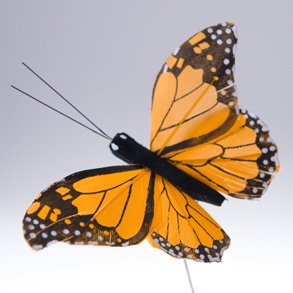
But the fight between the predators and the prey is much more intense among the smaller of the rainforest animals. Especially the weak have incredible defensive systems that can be found only in the rainforests. Take for instance the Monarch Butterfly. It is colorful and poisonous to the predators that eat them. So, in a move unique to rainforest species only, the monarch butterfly's defence is its colorful body. Once a predator dies after eating this butterfly, the rest stay away from this particular color of prey.
Due to the rich ecosystem, most rainforest animals are herbivores then carnivores. On the other hand you have plants that are rather carnivorous. Compared to that, the larger predators like leopards, tigers, alligator, and crocodiles all have a moderate population in the forests. And then you have small seemingly harmless rainforest animals like poisonous frogs, spiders, and insects etc which are the more voracious predators in the forest.
Being a self contained ecosystem, all rainforest animals play their own part in the maintenance of the ecosystem. This kind of harmony is rarely to be seen outside of rainforests, as outside interference from humans have fractured most other eco-systems. Unfortunately, the continuous threat from encroaching farmland and illegal logging is cutting into these rainforests and the rainforest animals are now entering the endangered species lists all over the world. We still have time to save the rest of the rainforest animals by taking steps to safeguard their unique world.
The Fastest Animals in Africa
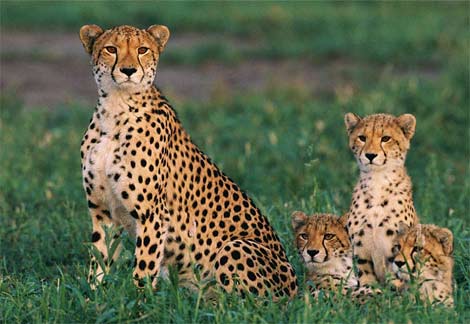
The cheetah is the world's fastest land animal and can reach speeds of up to 113 km/h (70 mph). That's around 0-30 mph in as little as 3 seconds (as good as most Ferraris), and it can retain its cruise speed for several hundred meters (+/- 400 m). The long legs have non-retractable claws which enable extra grip on the ground, and the cat uses its tail for proper balance and change of direction.
2. Lion
Over 250 kg of pure and powerful muscle, which can run as fast as 81 km/h (50.3 mph)! Not bad for the "king of the jungle", huh?:)
3. Wildebeest
Preyed upon by lions and occasionally cheetah, wildebeest'd better run fast if they want to keep up with their assailants! They may have poor eyesight, but their pace is rather impressive: up to 80 km/h (50 mph)!
4. Ostrich
The ostrich is by far the best bird runner out there, and also the fastest two-legged animal in the world. Although it cannot fly, it sure can run: 72 km/h (45 mph)!
5. Thomson's Gazelle
In the Serengeti plains, these little guys are a cheetah's favourite meal! Easy prey you might say, but Thomson's gazelles have great stamina and legs that propel them to speeds in excess of 65 km/h (40 mph)! Nine times out of ten, they will outrun any predator over longer distances, and can produce sharp turns with ease.
6. African Wild Dog
Also known as "Cape Hunting Dogs", or "Painted Hunting Dogs", these wild dogs have the greatest success rate while hunting (85%). Their speed is also somewhat remarkable, with sprints of up to 64 km/h (39.7 mph)!
7. Giraffe
Giraffes have a unique "slow motion" running style! The cowl does not make the monk, as they can easily reach speeds of 50 km/h (31 mph).
8. Hippo
Yep, you heard me right, the hippo is part of Africa's top 10 fastest animals! Hard to believe? They can speed up to 48 km/h (30 mph) on land, and can even run as fast as a man can walk while under water. Bring it on Mr. Usain Bolt, you still have a bit of workout to do!:)
NB: Just to put things into perspective, Usain Bolt (the fastest man alive 'til this day) ONLY runs at 37.57 kph (23 mph). Easy peezy, run this in my sleep!;):) In other words, he wouldn't even make it in this listing.
9. Rhinoceros
45 km/h (27.9 mph) for the Black rhino, and about 40 km/h (24.8 mph) for the White rhinoceros over short distances. Not to be disturbed!
10. African Elephant
9-12 km/h is usually the norm, while full charge "get out of the way" pace easily reaches speeds upwards of 40 km/h! Rumor has it that a charging elephant can be stopped by throwing a big stone (or log) in front of the animal's fore feet. Have never tried it, but wouldn't recommend you taking the risk though...an elephant charge is something you won't forget!:)
Reasons That People Abuse Animals
Plants and animals balance each other in an ecosystem. While most animals are predators, plants provide food and oxygen for the animals. On the other hand, animals also do their part in the food chain during the process of decay as it provides nutrients that are needed for healthy plant growth.
The food chain and the ecosystem becomes unbalanced once human beings who do not understand proper use and conservation of resources come into the picture. These people do not only exhaust all the plant resources but they also abuse and mistreat the animals that depend on them.
* These people have been exposed to violence themselves.
Some people who abuse them and other people may have been treated violently when they were younger. Because of their feeling of helplessness when they were young, they tend to look for another being to whom they can exert some force.
Also, those who have just witnessed a lot of violence are also likely to pass on this actions to other people and other living things. These people might view violence as the norm of life and is just living what they think is normal.
* Animal abusers believe that animals do not deserve respect.
A common belief of those people that abuse them is that they are lower forms of being and should not be respected. While it may be debatable as to whether they are lower forms of creation or whether they are equal to human beings, those who know the role that these organisms play in the ecosystem will agree that they also deserve some respect.
* These people lack education on how to treat them properly.
Animal abuse usually occur in places or households where the people lack education on proper pet treatment. Some of these people think that they are toys that do not experience pain, hunger and fatigue. Once these people are educated on how to treat them, most of them change towards creating a better environment for their pets.
* Those who abuse animals would like to maximize the benefits that people can get from animals.
These people treat animals like slaves. They believe that once they own these animals, they can do whatever they want with them. They make their animals work until they reach their limits or live through the day without food. Again, sufficient education will make these people change these views on treating these animals. While animals can help in some chores, like human beings, they should also be fed and allowed to rest.
While animals and human beings are biologically different, they share some similarities. Both experience hunger, thirst and pain. Every form of creation deserves respect.
There's More to Working With Animals Than Becoming a Veterinarian
Maybe you're squeamish or the thought of injured animals makes you sad. Or maybe you don't feel like dedicating years and years (and lots of money) to a formal education. Or maybe you just aren't that into medicine, science, etc. Whatever the reason, there's a whole other side to working with animals that's in the care giving capacity. Think of all the people you trust your pets with when you're not around-from your dog walker, to your cat sitter, to your groomer, to your kennel operator-all of these people have one very important thing in common. They are caring for your animal(s).
People who work in non-medical pet care giving tend to like animals and enjoy being around them. These jobs don't pay as much as, say, a veterinarian at a busy practice or a television show host, so most people who work these kinds of jobs aren't in it for the money so much as the reward of helping animals (and their people) live the lives to which they are accustomed. In short, these people like to work directly with their clients (pets) and the pets' human companions.
First up are professional pet sitters, who are tasked with unique responsibilities. In most cases, they take care of their charges in their client's homes, so not only do they hang out with and entertain cats and dogs (and maybe even birds, fish or lizards), but they also need to be discreet and trustworthy. Being licensed and bonded, as well as having liability insurance, helps alleviate any qualms clients may have in this regard. Most pet sitters belong to Pet Sitters International (PSI), and some also become PSI-Accredited. Along the same lines, professional dog walkers/runners deal directly with dogs and their owners, and are also often in their client's homes when they are away at work or on vacation, so being licensed and bonded helps gain credence with clients.
Taking it a step further are doggie day care providers, who offer pet sitting in groups in their own home or in a professional facility. Some doggie day care providers offer the works, such as swimming and play time, and others are no-frills and the animals spend most of the day in crates. The more successful doggie day care providers offer play time, individual walks, and nice cozy "apartments" for dogs to nap in.
Pet boarders/kennel operators offer extended stays beyond that of doggie day care, so that people can leave their cats, dogs, birds, fish and sometime seven lizards in safe custody and under watchful, caring eyes. Again, some pet boarders/kennel operators offer bells and whistles such as individual play time and walks, and some are no frills.
Animal grooming is sometimes offered at kennels, doggie day care centers, and veterinary offices, as well as pet supply stores. Other animal groomers work out of their home or even take it on the road by offering mobile services. Animal groomers enjoy not only working closely with animals, but also getting their hands dirty and then making something pretty out of all the mess. Animal groomers must understand various breeds (mainly cats and dogs) and know both how to groom them and how to groom them in such a way that is considered acceptable (also knows as the breed standard). Animal groomers should have at minimum a business license and liability insurance, and a degree from a professional grooming school is also a good idea (this isn't required, but really, who is going to trust a groomer with one?). In addition, the National Dog Groomers Association of America offers groomer certification, and they are also the only school for pet groomers recognized at a national level.
For animal lovers who are compassionate and enjoy one on one time with dogs and cat (as well as birds, fish and other creatures), a career in non-medical pet care giving is a good choice. As these careers typically require less formal schooling and training, they are also good door openers to other animal related careers.
Animals in Space
The first animals deliberately sent into space were some American fruit Flies in 1947.
First Primate
The first primate in Space was Albert II in 1949. Albert was a rhesus monkey. Unfortunately, his parachute failed and he died.
First Rodent
An American Mouse went into space in 1950. I think this was the first rodent in space.
In 1951, two Russian dogs went into space. Their names were Tsygan and Dezik. These early pioneers of space flight did not get into Earth orbit.
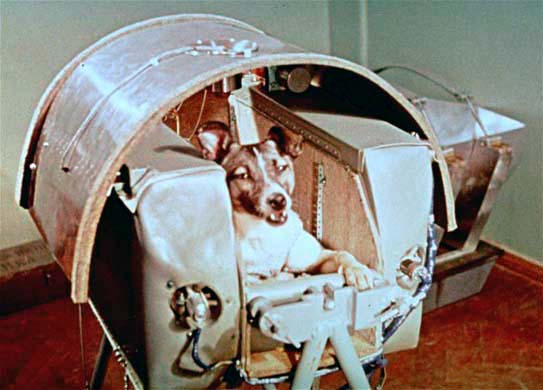
The first animal to make a complete orbit of the Earth was a Russian dog named Laika. Unfortunately Laika did not survive the flight.
Many animals died in the early days. The first monkeys to survive space flight were American. They were called Able and Baker. This was in 1959.
Two dogs went into orbit on the 19th of August 1960. They not only survived the ordeal, but one of them, Strelka later had puppies. One of these was given as a present by the chairman of the council of ministers of the Soviet Union, Nikita Khruchev, to Caroline Kennedy. This dog's descendents still exist.
Piloting Spacecraft
Although these animals went into space, they did not have to do much. It was not really known if it was possible to do normal things in space. This was important. A pilot needs to be able to pilot his craft.
To test this, the first Ape was sent up. On January the 31st 1961, Ham, a four and a half year old Chimpanzee, went up and successfully performed the tasks set. Ham survived his sub orbital flight and was congratulated after landing.
First Rat
A French Rat went up on the 22nd of February 1961.
First guinea Pig
A Russian Guinea Pig went into space on March the 9th 1961.
First Human
On April the 12th 1961 the then Major Yuri Alekseyevich Gagarin made his historic orbit of the Earth and was hailed as a hero on his safe return. Animals continue to play an important role in our extraterrestrial investigations.
On October the 31st 1963, France launched a cat named Felix into space. Felix returned alive.
First Fish
On April the 16th 1972, Skylab 3 had Killifish. It also had spiders, and the first spider web was built in space.
Deep Space
Although both Animals and Humans had survived close to The Earth, they were still protected to some extent by our planet's magnetic field. There was still the question of whether we could survive away from this protection.
First Tortoise
One of the first animals to go round the Moon was a Russian Horsfield's Tortoise on September the 14th 1968. It was accompanied on its pioneering voyage by Meal Worms and Wine Flies.
Water-bears
In September 2007, the European Space Agency sent up some Tardigrades. This is a tiny animal also called a water-bear. These hardy animals survived the vacuum of space without protection for ten days.